By Daily Carry Lab. Primary documentation checked October 15, 2026 (Pacific).
Affiliate disclosure: As an Amazon Associate, Daily Carry Lab earns from qualifying purchases. Retailer links may earn a commission at no extra cost to you.
Research disclosure: We reviewed manufacturer instructions and specifications, including the actual downloaded manual identities. We have not tested charge termination, cell capacity, heat, charge time or power-bank performance. No DCL scores or safety-certification findings are claimed.
For a removable-cell travel kit, match the battery’s chemistry and voltage before counting charging slots. AA and AAA describe a physical format, not a universal charging requirement. A USB-C rechargeable cell with its own electronics is not automatically suitable for a cradle built for 1.2V NiMH cells.
Our documented starting point is Panasonic BQ-CC87, with the white BQ-CC87ABBA retailer SKU identified separately. We also examined XTAR VC2SL, a two-bay USB-C alternative. Its product catalogue supports a narrow specification comparison, but we are holding its purchase recommendation because the manual download reviewed did not match the named model. This is a selection based on available documentation, not a ranking of tested charging performance.
Compare chemistry, capacity and input
| Model | AA/AAA charging path reviewed | Slots and upstream input | Main decision |
|---|---|---|---|
| Panasonic BQ-CC87 | NiMH rechargeable AA/AAA; manufacturer recommends Panasonic NiMH cells | Any combination of 1–4 AA/AAA; Micro-USB input, DC 5V 1A supply requirement | Four-cell travel kit if carrying the documented Micro-USB cable is acceptable |
| XTAR VC2SL, recommendation held | Catalogue lists 1.2V NiMH AA/AAA among supported sizes; also lists separate 3.6/3.7V Li-ion sizes | Two bays; catalogue specifies USB-C, 5V 2.1A input | Potential two-cell USB-C option, subject to obtaining correctly matched operating instructions |
Sources: Panasonic operating instructions and the VC2SL row on printed page 27 of XTAR’s catalogue. A lithium-ion size list does not approve every AA-shaped lithium battery. Neither row establishes support for rechargeable regulated 1.5V lithium AA/AAA cells.
If your device uses three cells, a four-slot arrangement can cover that set together; two slots require separate sessions. That is capacity arithmetic, not a faster-charger claim. Do not choose by a maximum advertised current alone: cell capacity, chemistry, input power and the model’s control behavior affect charging, and we have not timed either unit.
Panasonic’s charging and USB-output modes are different
The BQ-CC87 manual identifies a Micro-B charging input and USB-A output. For charging, it specifies a DC 5V supply rated at 1A or more, with per-cell LED indications and room for one to four AA/AAA cells in different combinations. Use the documented cable and polarity arrangement. A USB-C wall charger in your bag does not by itself supply the needed Micro-B cable.
Input power also changes the documented behavior. The manual describes timer charging when supply capability is below 1A but above 0.5A, and says the charger will not charge below 0.5A. Treat a low-power shared USB outlet as a limitation to check, rather than assuming the number of occupied slots proves adequate power. Follow the instructions for your exact unit; we do not certify an unknown outlet or cable.
Its separate mobile-boost instructions use four installed cells and provide DC 5V 1A USB output. Those instructions permit alkaline batteries for that output function. They do not permit charging alkaline batteries. We do not claim a percentage phone refill, or recommend buying this primarily as a replacement for a dedicated power bank. The manual also describes low-load output shutoff, so a small accessory’s behavior needs checking.
Why the VC2SL recommendation remains held
XTAR’s VC2SL store page documents two bays, USB-C input and automatically adjusted charging behavior. However, on October 15 the download from the manufacturer’s page titled VC2SL User Manual opened a VC4SL manual, showing four slots and different input/control specifications. We did not use that file as VC2SL operating evidence.
Obtain the actual VC2SL instructions from XTAR before purchasing for a particular battery set. Do not transfer VC4SL charging-current settings, chemistry support, storage or grading features to VC2SL. Until the mismatch is resolved, this guide does not provide a VC2SL retailer recommendation or operating procedure. The catalogue comparison helps identify the candidate; it does not replace correctly matched instructions.
Budget and drawbacks
| Choice | Exact delivered price evidence, October 15 | Additional items or unresolved cost |
|---|---|---|
| Keep an existing compatible charger | No new cradle purchase if its instructions match your cells | Correct supply, cable and enough slots still required |
| White Panasonic BQ-CC87ABBA | Current checkout total unknown | Compatible cells, 5V supply and Micro-USB cable/package contents; no regional warranty promise |
| XTAR VC2SL, held candidate | Current checkout total unknown | Correct manual and cell-specific confirmation before a purchase recommendation |
This guide selects a cradle for removable cells. Our USB-C rechargeable AA battery guide addresses cell choice and device fit separately; charging through a cell’s own socket is a different path. If a cradle is needed, first settle chemistry, the exact instructions and how many cells you charge together, then compare current complete-kit prices.
Read the BQ-CC87 lights before replacing the cradle
The BQ-CC87’s cell indicators describe charging status, not a measured battery-capacity test. Panasonic calls their remaining-charge indication a rough estimate. That matters when you are deciding whether a partially charged cell needs more time or whether equipment needs attention. Use this only with the documented rechargeable cells and charging mode above. BQ-CC87 US instructions, English page 1, checked October 22, 2026.
| Observation during charging | Documented meaning or check | What it does not prove |
|---|---|---|
| Green lights sweep at startup | About three seconds of cell-status evaluation before charging | Not completion of the charge |
| A cell’s light is green | The status chart places it at 80% or more | Not a full-charge confirmation |
| Charging lights turn off completely after charging | Panasonic’s normal completion indication | Not a measured usable-capacity result |
| Lights fail to appear or blink unexpectedly | Check insertion/contact, power connection and that cells are rechargeable and undamaged | Do not label every blink as a worn battery |
Record the pattern and which mode you are using before comparing it with the manual. The same device also has USB-output indications, so a pattern seen while powering an accessory should not be read as a charging result. The lower-input timer mode described earlier also means lights going out cannot be interpreted without knowing the supply and preceding sequence.
For packing, confirm the intended charge cycle rather than removing cells as soon as a green light appears. If an unexplained fault persists after the documented checks, obtain support before buying replacement cells or a cradle on that observation alone. This is an interpretation aid, not a fault diagnosis or permission to charge damaged or non-rechargeable batteries.
Keeping a compatible functioning cradle avoids a new cradle purchase; current cell, supply and service costs remain unknown. We have not measured cell health, termination accuracy or actual runtime after charging.
Can BQ-CC87 replace the separate USB power bank?
Only treat BQ-CC87’s mobile-boost function as part of the kit after checking the output instructions, rather than its flexible charging-slot arrangement. Panasonic’s US operating instructions, English page 1, checked October 24, 2026, describe a 5V/1A USB supply using four fully charged NiMH or alkaline cells. The step-by-step procedure calls for four AA cells, and Panasonic recommends AA to maximize mobile-boost power. This does not make a partly occupied charger an established USB reserve.
| Plan | Documented output boundary | Buying consequence |
|---|---|---|
| Reuse cells carried for another device | The output procedure calls for four AA cells | Count an available complete set, not merely the number of charging slots |
| Power a small USB accessory | Output stops after about one minute if current falls to 50mA or less | A 1A maximum does not establish continuous service at low draw |
| Charge a phone needing higher power | Output is5V/1A, or5W by multiplication | This is not evidence of a higher-voltage fast-charge profile |
| Use alkaline cells for mobile boost | Permitted in this separate output mode | Alkaline permission does not extend to the charging function |
For example, if all four compatible cells are installed in another device, the cradle does not simultaneously have that same set available for USB output. This is an inventory constraint, not a measured runtime estimate. Decide which device gets the cells and whether another set would actually simplify the bag.
The low-current cutoff also matters when an accessory finishes charging or draws intermittently. We have not measured its draw or tested continuous operation, so neither its small size nor the charger’s remaining-charge lights establish compatibility. Check the accessory’s input requirements and validate the actual arrangement before relying on it.
Complete-kit budget: count the cradle, four suitable cells, the required USB-A output cable and the supply/cable needed to recharge NiMH cells later. Current delivered totals and phone refill capacity are unknown. Keeping a suitable dedicated bank may be simpler when this cell allocation or cutoff conflicts with the task. Conversely, an already-owned functioning cradle can be evaluated before purchasing another reserve. We make no comparative efficiency, faster-charging or endurance claim, and VC2SL’s unresolved manual identity remains held.
Four slots and USB-C: what the BC4 changes, and what it does not
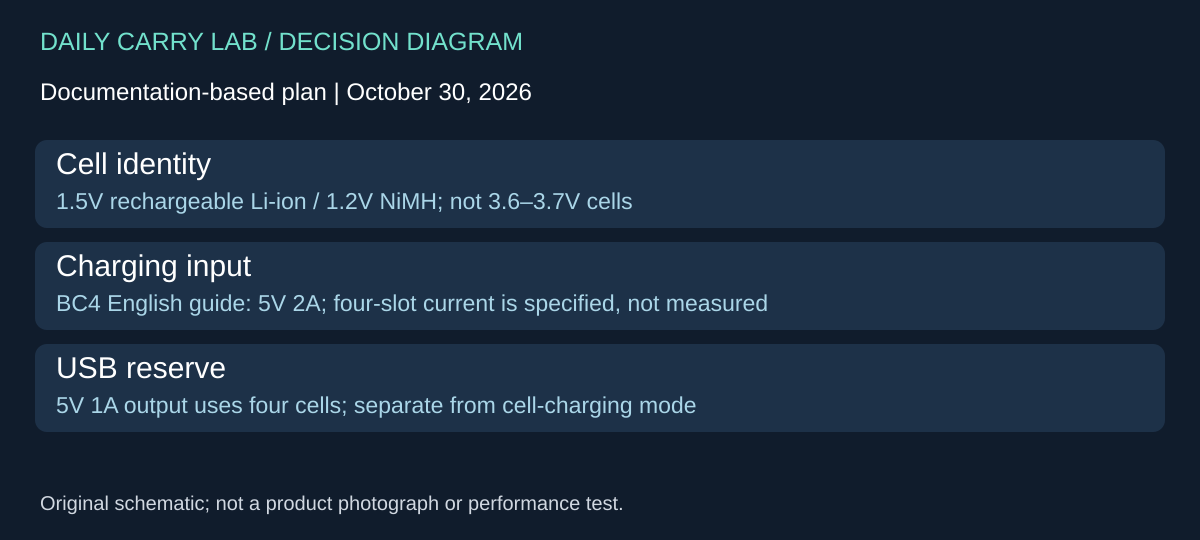
XTAR BC4 is a different four-cell candidate from the BQ-CC87: its own operating guide documents 1.5V rechargeable lithium-ion and 1.2V NiMH AA/AAA, with USB-C input. It can therefore be considered when the charging connector or a permitted 1.5V cell system is the reason for changing a NiMH-only cradle. It does not turn all AA-shaped batteries into interchangeable charging choices. The official BC4 page links the BC4 operating manual; we checked the model cover and English sheet on October 30, 2026.
| Exact BC4 check | English manual specification or restriction | Buying consequence |
|---|---|---|
| Charging chemistry | 1.5V Li-ion and 1.2V NiMH AA/AAA; excludes dry cells and 3.6/3.7V Li-ion | Match the exact cell instructions, not just AA dimensions or a lithium label |
| Upstream power | DC 5V 2A input; 0.5A × 4 charging current listed | Include the specified supply and suitable USB-C cable; this is not a measured charge time |
| USB reserve | 5V 1A output; output instructions use four powered cells while not charging | Count a complete available set; do not plan simultaneous cell charging and USB output from this procedure |
| Low upstream supply | Manual says charging current is reduced when supply is insufficient | A shared low-power socket does not establish the listed four-slot current |
XTAR’s current store description identifies four independent slots and simultaneous AA/AAA charging. That is useful when choosing a charging layout, but it does not override cell instructions or authorize mixing batteries in a particular device. A regulated 1.5V rechargeable cell and a 3.6/3.7V 14500 can share a similar shape; the latter is explicitly outside the BC4’s permitted charging and discharging scope. Do not infer that the cells discussed in our separate battery guide are approved for this cradle without checking their exact maker instructions.
The output mode is also narrower than a generic “power bank” label suggests. For discharging, XTAR recommends AA cells of the same type, brand and similar condition, and discourages AAA for better discharge performance. Its permission to discharge dry cells does not permit charging them. The manual warns that regulated 1.5V lithium cells can show four green lights throughout discharging, so those lights do not establish a useful remaining-runtime measurement for that chemistry.
Budget and drawback: BC4 may consolidate a specifically compatible cell kit around USB-C, but complete delivered costs and exact seller package contents remain unknown. Confirm the cable, supply, cells and storage arrangement together. We have not measured charge termination, heat, usable USB energy or cell runtime. Keep a working BQ-CC87 if its NiMH support and Micro-USB arrangement already meet the need. The new BC4 evidence does not resolve the unrelated VC2SL manual mismatch above, and no new retailer recommendation is established here.
Plan the recharge window before choosing higher-capacity cells
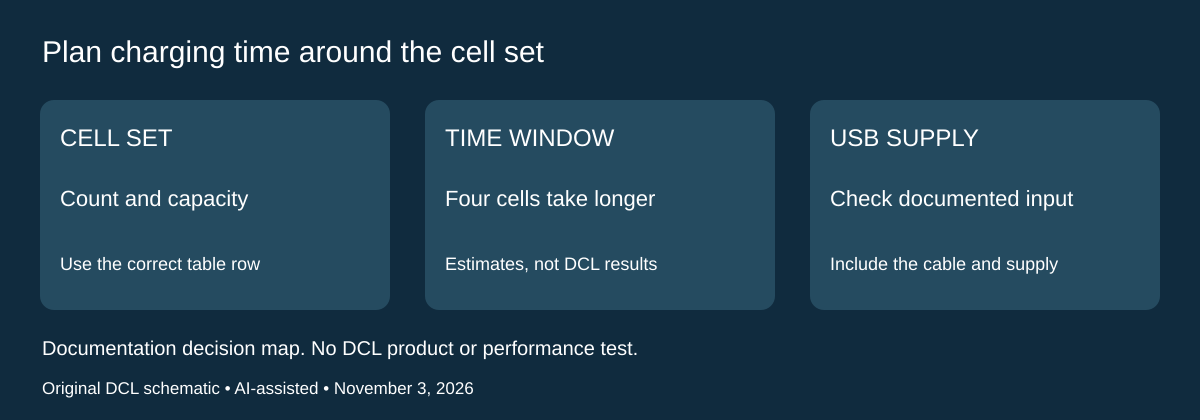
For a travel charger, four slots do not establish a quick turnaround for four depleted cells. Panasonic’s BQ-CC87 US instructions, English page 1, Table 1, checked November 3, 2026, give different approximate times by capacity and cell count. Use the row for your actual NiMH cells; a larger capacity can add a scheduling cost as well as stored energy.
| Fully discharged cell set | Maker’s approximate time, 1–2 cells | Maker’s approximate time, 3–4 cells | Planning consequence |
|---|---|---|---|
| AA, 1900–2000mAh | 2.25 hours | 4.5 hours | A short charging stop may not refill a four-cell set |
| AA, 2400–2550mAh | 3 hours | 6 hours | Higher capacity asks for a longer recharge window |
| AAA, 750–800mAh | 2 hours | 4 hours | Match the smaller-cell row rather than using the AA figure |
These are Panasonic’s estimates for fully discharged batteries, not DCL timing results. Starting charge and ambient temperature affect actual duration. The manual specifies indoor charging at 0–35°C. A departure deadline does not make a green charging light equivalent to completion: Panasonic identifies complete charge by the LEDs turning fully off.
The upstream USB supply is another purchase check. Panasonic calls for DC 5V at 1A or more. It says a supply below 1A but above 0.5A uses a timer mode that switches off after 13 hours, while below 0.5A the charger will not charge. Do not apply Table 1 as a promised schedule for an underpowered USB outlet. These are the BQ-CC87’s instructions and do not establish the behavior of XTAR’s alternatives.
Selection and budget: list how many cells your device consumes, their exact chemistry/capacity and the charging time actually available between uses. Compare a compatible spare set with choosing a different documented charger when that window is inadequate. Include the proper supply, cable and any spare cells in the total; current prices remain unknown. No timed-charge winner, measured battery endurance or guarantee that splitting a set into two sessions saves time is claimed. Keep usable cells you already own when their documented charging plan meets the trip.
Shop the researched models
These Amazon links are affiliate links. Daily Carry Lab may earn a commission from qualifying purchases. Match the model and included contents to your needs; this guide is based on manufacturer-source research, without hands-on testing.
-
Panasonic BQ-CC87ABBA
White;retailer regionalSKU;primary US manual BQ-CC87base;bundle/warranty unknown
Check Panasonic BQ-CC87ABBA, white, on Amazon
Sources and limits
This guide compares published specifications and source documentation. Daily Carry Lab has not performed hands-on tests of the products in this guide. Consult the dated sources and verify the exact model and current terms before buying.
- Panasonic BQ-CC87 US operating instructions
- XTAR product catalogue
- XTAR VC2SL official store specifications
- XTAR page labeled VC2SL User Manual
- October 30 charger primary documentation
- October 30 bc4-product primary documentation
- October 30 bc4-manual primary documentation
- BQ-CC87 Table1 times, operating instructions point3 and temperature range
Related guides
iPhone 18 Pro: Wrist Strap or Crossbody Strap, with the right case
Compare exact Apple Wrist and Crossbody strap packages for iPhone 18 Pro by attachment, length, complete cost and limitations.
Portable label makers: choose phone control or a built-in keyboard
Compare Brother PT-P300BT CUBE and PT-H110 by phone dependence, TZe tape widths, power and cable-label workflow.
USB-C bike front lights: compare modes, mounts and charging
Compare Lezyne Micro Drive 800+ and Fenix BC15R using exact modes, rated runtime, battery design and mounting limits, without road-certification claims.
Camera backpacks for travel: dividers, access and laptop fit
Compare Peak Design Everyday Backpack 20L v2 and Lowepro ProTactic BP 350 AW III by camera access, laptop clearance, weight and packed dimensions.